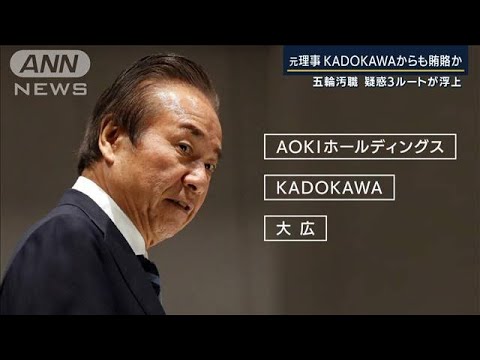
The chain of suspicions surrounding the Olympics continues unabated. The Tokyo District Public Prosecutors Office’s Special Investigation Department has launched a compulsory investigation of related parties such as “AOKI”, a major men’s clothing company, regarding Haruyuki Takahashi, former director of the Tokyo Olympics and Paralympic Games Organizing Committee. Takahashi (78) was re-arrested for receiving bribes from executives of major publishing company Kadokawa. KADOKAWA’s former head of charge, Kyoji Maniwa (63), and former managing director Yoshiyuki Yoshihara (64) were arrested on suspicion of bribery. The two are suspected of giving a bribe of about 69 million yen to Takahashi, asking them to “receive convenience” in selecting a sponsor for the tournament. As an official supporter of the Olympic Games, KADOKAWA publishes official programs and guidebooks for the Games. KADOKAWA Chairman Tsuguhiko Kadokawa: “(Q. Are you aware that you gave a bribe?) There is absolutely no such feeling. I have never run a business for 50 years. Please don’t do it with me.” He admitted that he paid an acquaintance of Takahashi about 70 million yen as a fee. The suspicion of funding Takahashi has expanded to three routes. The special investigation unit indicted three people, including the former chairman of AOKI Holdings, Hironori Aoki (83), on charges of bribery on the 6th. According to people involved, defendant Aoki admitted to bribery and made a statement to the effect that “I was aware that Takahashi was in an important position. I instructed my subordinates to ‘do what I can ask.'” It is said that Furthermore, on the 5th, the Special Investigation Unit embarked on a search of the house of the major advertising company “Ohiro”. It is suspected that money was passed from AOKI Holdings to a company run by Takahashi, and from KADOKAWA and Ohiro through a consulting company run by an acquaintance of Takahashi. His acquaintance, Kazumasa Fukami (73), was arrested on suspicion of accepting bribes on the 6th, accusing him of conspiring with Takahashi to commit the crime. Fukami is also from Dentsu, the largest advertising company, and is said to be five years younger than Takahashi. A Dentsu official who knows Fukami: “He was a person who worked for a publisher for a long time as a point of contact for advertising. Department: A person who spent a long time in a department that has a lot of relationships with publishers, and what you would call an executive employee at Dentsu.I think he had a fairly deep relationship with KADOKAWA.” Takahashi’s company is Commons. Fukami’s company is Commons 2. Furthermore, when I checked the registry of Commons 2, there was a name of Takahashi suspect as a former director. In 2013, the year after its establishment, Takahashi was first appointed as a director. Three and a half months later, Fukami became a director. After that, Takahashi resigned in the form of entrusting Fukami. Regarding Fukami, Chairman Kadokawa said: KADOKAWA Chairman Tsuguhiko Kadokawa: “That person was the head of Dentsu’s magazine department, so I thought he was ‘a person from Dentsu.’ I thought he was from Dentsu, so I didn’t feel any discomfort. KADOKAWA: “We take this matter very seriously, and will continue to fully cooperate with the investigation by the authorities, including responding in good faith to requests from the Tokyo District Public Prosecutor’s Office.” I would like to ask Nobuhide Nishimae, a reporter in charge of the judiciary of the Social Affairs Department. (Q. Suspect Takahashi is a “deemed public employee” and is considered to be accepting bribes. Why is Suspect Fukami, a private citizen, accepting bribes?) Although it is a crime, there is a provision in the Criminal Code called “accomplices without status.” will be According to those involved, both Takahashi and Fukami were from Dentsu, and since then they had a close relationship as seniors and juniors, and even after becoming independent, they were doing business with each other. This time, the funds from KADOKAWA’s former managing director and others were paid to Fukami’s company, but the Special Investigation Department determined that it was a bribe related to Takahashi’s duties, and that he and Takahashi had received it together. It seems that (Q. How should we look at the movement involving multiple companies, such as AOKI Holdings and KADOKAWA, and the successive arrests?) There is an aspect of a race against time. The Special Investigation Unit is believed to be investigating other companies involved in the selection of sponsors for illegal money flows surrounding the Olympics. However, there is the issue of statute of limitations. The statute of limitations for bribery is three years, but one year has already passed since the Olympics were held. Considering the time when the sponsor was decided, even if an illegal flow of money is found in the future, it can be said that it is already at the last minute, and it seems that the point will be whether or not the statute of limitations will be charged in the future. In addition, since a large amount of money was flowing around the Tokyo Olympics and Paralympics, it seems to be important whether the money passed to Takahashi’s side is flowing “beyond”.
[テレ朝news] https://news.tv-asahi.co.jp

JP2021.COM