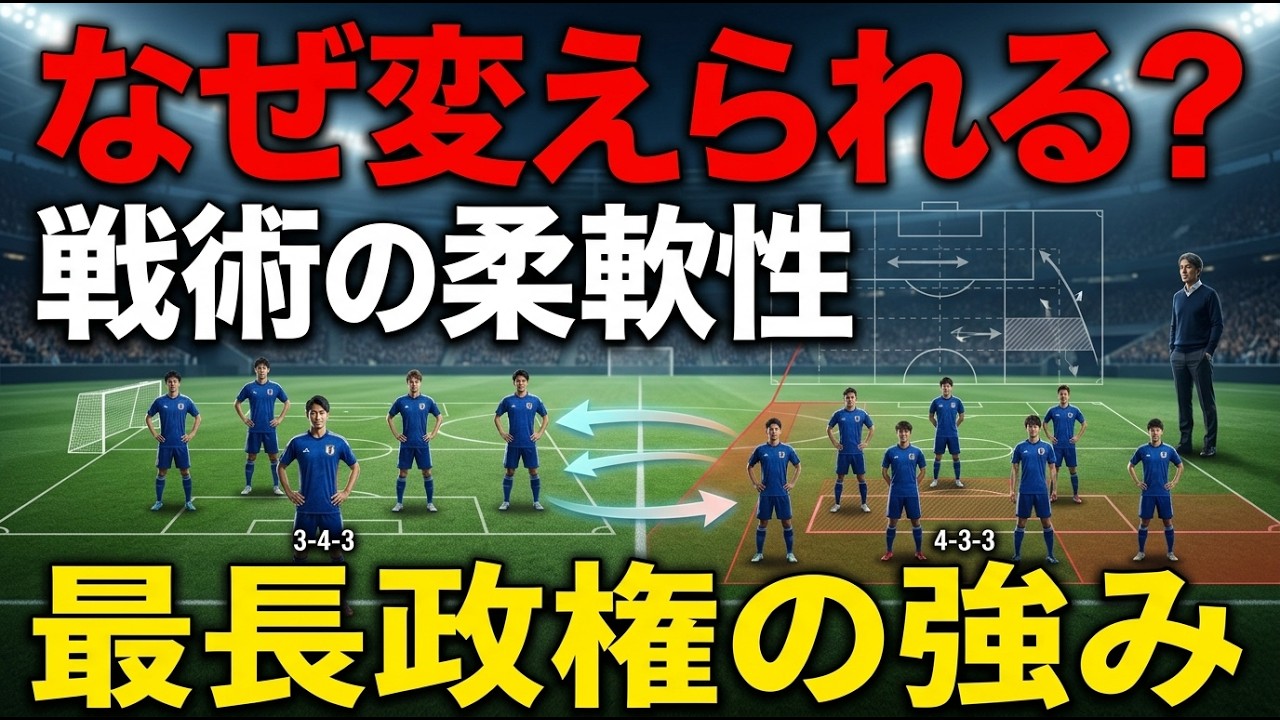
After watching Hajime Moriyasu’s performance on the Japanese national team, I was convinced that the strength of the longest-serving team lies not in simply accumulating results, but in the ability to switch back and forth between the three and four backs. Rather than being fixed to one system, he smoothly transitions to the optimal form depending on the opponent and match situation. This “variability” is one of the reasons why Moriyasu Japan can take the lead even against strong opponents. In the back three position, he utilizes his width and forward movement as a wing-back, as well as his stable block formation when defending. In the back four, density in the midfield, balance when holding the ball, and diversity in the build-up. By being able to go back and forth between these two structures during a match, the Japanese national team is now able to always choose the optimal solution according to the situation. What is important is not the system change itself, but that the players understand the intention and are able to play to the same standards. Wataru Endo’s positioning, Takehiro Tomiyasu’s line leadership, and the changing roles of Takefusa Kubo and Kaoru Mitoma – a variable system has been established precisely because each of these functions as “part of the structure.” In this video, we will focus on Moriyasu Japan’s tactical flexibility and thoroughly explain why the “designed variability” that can only be achieved by a long-term government is connected to the strength of the Japanese national team. “Should the system be fixed or should it change?” The current Japanese national team has an answer to that question. Please watch until the end and let us know your thoughts in the comments! #Japan National Team #Moriho Japan #Tactical Analysis #3 Back #4 Back #Variable System #Takefusa Kubo #Kaoru Mitoma #Wataru Endo #Takehiro Tomiyasu #Overseas Reaction #SamuraiBlue #World Cup 2026 #Soccer Commentary #football

JP2021.COM