
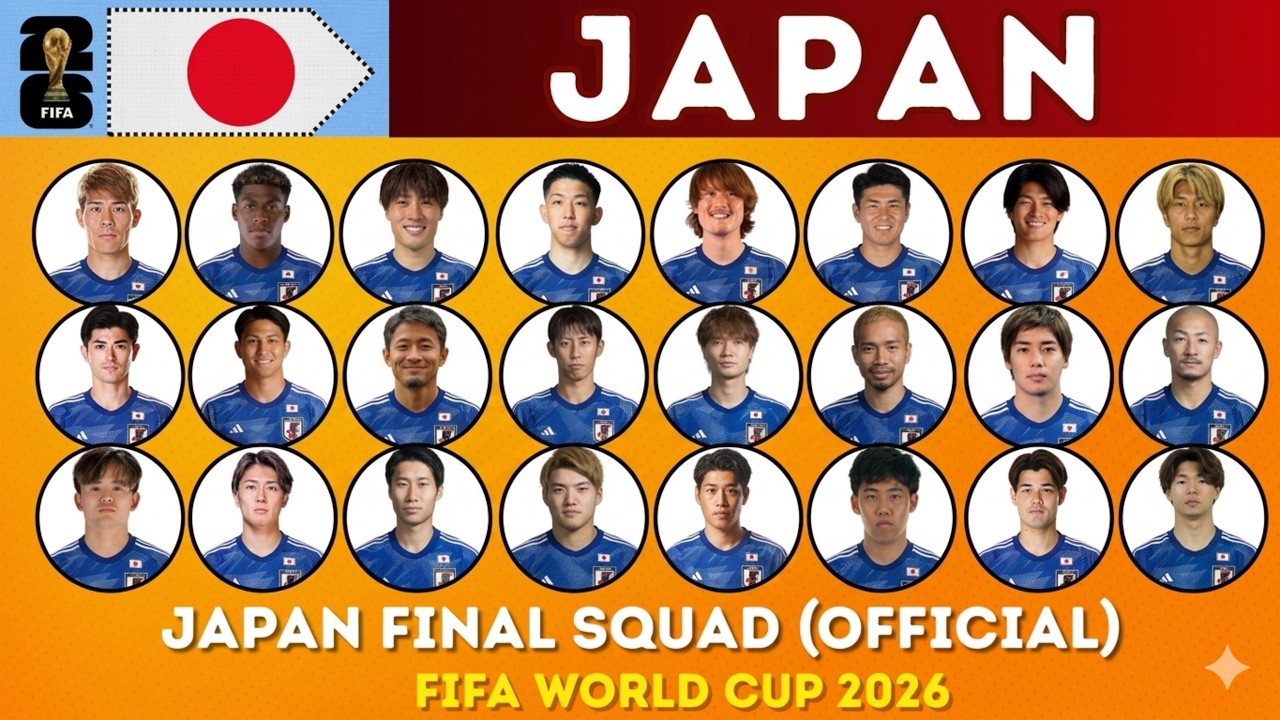
Japan’s 2026 World Cup Squad: Full Roster, Key Players & Tactics
Explore Japan’s final squad 2026 for the FIFA World Cup with manager Hajime Moriyasu leading the Samurai Blue. This national team roster features Premier League stars Wataru Endo (Liverpool) and Daichi Kamada (Crystal Palace), Bundesliga talents Hiroki Ito (Bayern Munich) and Ritsu Doan (Eintracht Frankfurt), plus La Liga playmaker Takefusa Kubo (Real Sociedad). Goalkeeper Zion Suzuki (Parma) anchors a defense including Takehiro Tomiyasu and Ko Itakura at Ajax. Midfield engine Ao Tanaka (Leeds United) links with forwards Ayase Ueda (Feyenoord) and Daizen Maeda (Celtic). From J1 League prospects to European veterans, this World Cup 2026 squad blends experience and youth for Qatar-style ambition in North America. Tactical flexibility, set-piece strength, and counter-attacking speed define Moriyasu’s game plan.
Timestamps
0:00 – Intro & Tournament Context
1:15 – Manager Hajime Moriyasu Overview
0:24 – Goalkeepers: Suzuki, Osako, Hayakawa
1:10 – Defenders: Tomiyasu, Ito, Itakura, Nagatomo
2:25 – Midfielders: Endo, Kamada, Doan, Tanaka, Kubo
03:05 – Forwards: Ueda, Maeda, Ogawa, Shiogai
Balanced squad with elite European core, but aging fullbacks (Nagatomo 39) raise durability questions. Endo and Kubo provide world-class control, yet lack of a clinical #9 could limit knockout ceiling. Strong in transition and set pieces, but vulnerable to high-press systems. Realistic ceiling: Round of 16, with upset potential vs. any group-stage opponent if defense stays organized.
#japan2026 #samuraiblue #worldcup #fifa2026 #japanfootball #wc2026
My Honest Opinion
Is Japan’s squad deep enough for a deep World Cup run?
Yes, but with caveats. The European-based core (Endo, Kubo, Tomiyasu) is elite, but drop-off after the starting XI is noticeable. Bench options like Keito Nakamura and Kaishu Sano offer energy, not game-changing quality. A favorable group draw is essential for progression beyond the Round of 16.
What formation will Moriyasu likely use?
Expect a flexible 4-2-3-1 or 4-3-3 hybrid. Endo anchors as single pivot, with Kamada and Kubo operating as dual #10s. Fullbacks Sugawara and Nagatomo provide width, while Ueda leads the line. Moriyasu prioritizes defensive shape first, then quick transitions through Kubo and Doan.
Can Japan realistically challenge for the title?
Not realistically. While they can upset any team on their day, lack of a world-class striker and limited defensive depth prevent genuine contender status. Top-8 finish would be a historic success; focus should be on group stage progression and building toward 2030.
Who is the absolute must-watch player?
Takefusa Kubo (Real Sociedad). His dribbling, vision, and set-piece delivery unlock defenses. When Kubo is confident, Japan’s attack flows. Pair him with Doan on the right and Kamada centrally, and he becomes the creative heartbeat of the entire tournament campaign.
How impactful are the young players like Suzuki or Gotō?
High potential, limited immediate pressure. Zion Suzuki (23) is already a reliable #1, but teenagers like Keisuke Gotō (20) are developmental prospects. Moriyasu will use them sparingly in group stage if results allow. Their growth matters more for 2030 than 2026 glory.
JP2021.COM