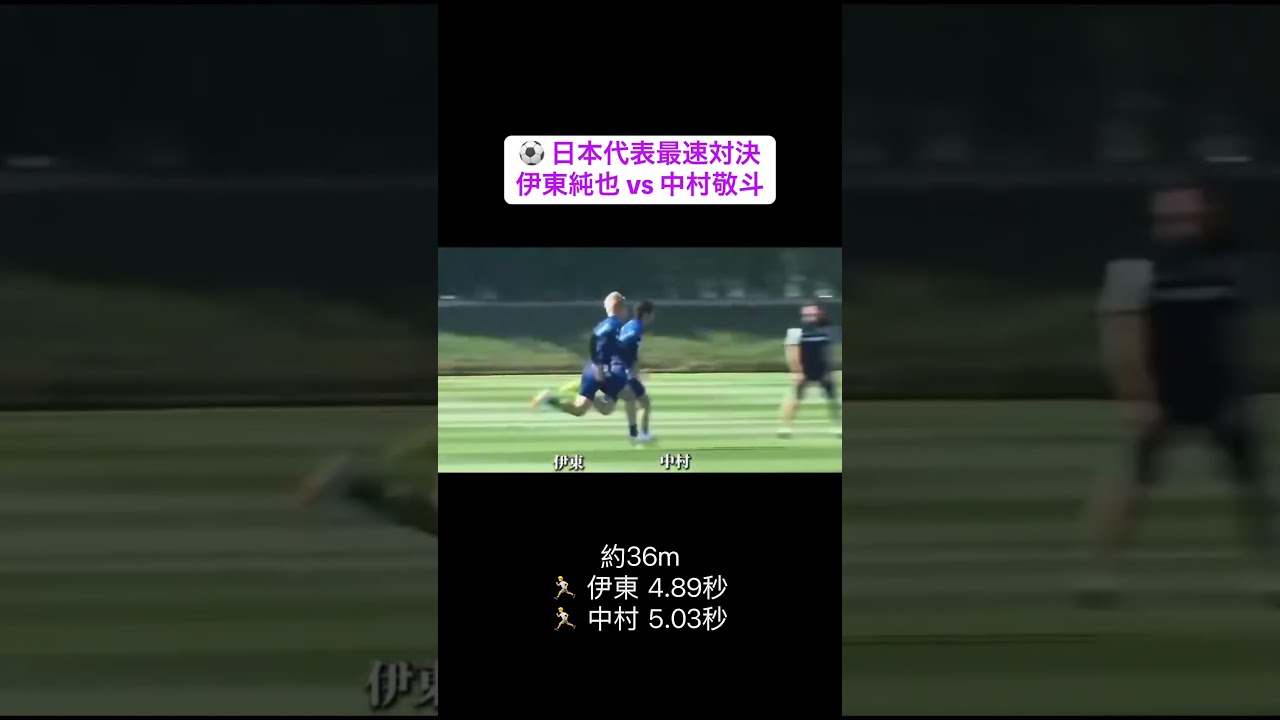
⚡️You can’t win just by being “fast”. It is the “first step” that determines the outcome. ⚡️ According to the data measured this time… 🏃♂️Approx. 10.3m Junya Ito: 1.99 seconds Keito Nakamura: 2.09 seconds 🏃♂️ Approx. 36m Junya Ito: 4.89 seconds Keito Nakamura: 5.03 seconds Junya Ito’s approximately 36m time is converted to each measurement method… ✅ Phototube measurement: Approximately 4.63 to 4.69 seconds ✅ Track and field style: Approximately 5.01 seconds (RT 0.120 seconds) Further converting to 40 yards (36.576 m)… 🇺🇸 Fastest in NFL history John Ross: 4.22 seconds (phototube) ⚽️ Junya Ito (estimated) 4.69 to 4.75 seconds (phototube) Even compared to the world’s top level, you can see that his sprinting ability is amazing. However, in soccer, top speed alone does not determine the outcome. The important things are… ✅ Acceleration power ✅ Timing of movement ✅ Ability to enter space before your opponent ✅ Repeated Sprint Ability High intensity runs and sprints will be more important than ever in the 2026 World Cup. Due to increased playing time and pressing from the front, the frequency of high-speed runs has increased, and games have become more explosive. (Reuters) Overseas as well, 📖 Haugen et al. (2014) “Sprinting ability is an important physical element that determines victory or defeat in elite soccer” 📖 Faude et al. (2012) “Many plays that directly lead to points are born from short sprints” 📖 FIFA Technical Study Group (2026) “In modern soccer, the ability to run at high speed and sprint has a greater influence on winning or losing than the total distance traveled.” (Reuters) In other words, it’s not about “maximum speed,” but “when, how many times, and how fast you can accelerate.” This is the most important sprint ability in modern soccer. We will continue to analyze the performance of the Japanese national team from the perspective of sports science ⚽️📊 #Japan Soccer National Team #Junya Ito #Keito Nakamura #Sprint #Sports Science

JP2021.COM